Space Heater Cost Calculator
Disclosure: This page contains affiliate links. If you buy through them we may earn a commission at no extra cost to you. As an Amazon Associate I earn from qualifying purchases. Details.
Electric heaters are easy to estimate because the label tells you the power draw. This calculator multiplies that by how long it runs and what you pay for electricity. State prices are the EIA's average residential prices for July 2026, the latest month available when we built this. Your utility's rate, including delivery charges and tiers, may be higher or lower, so for the most accurate number, enter the price per kWh from your bill.

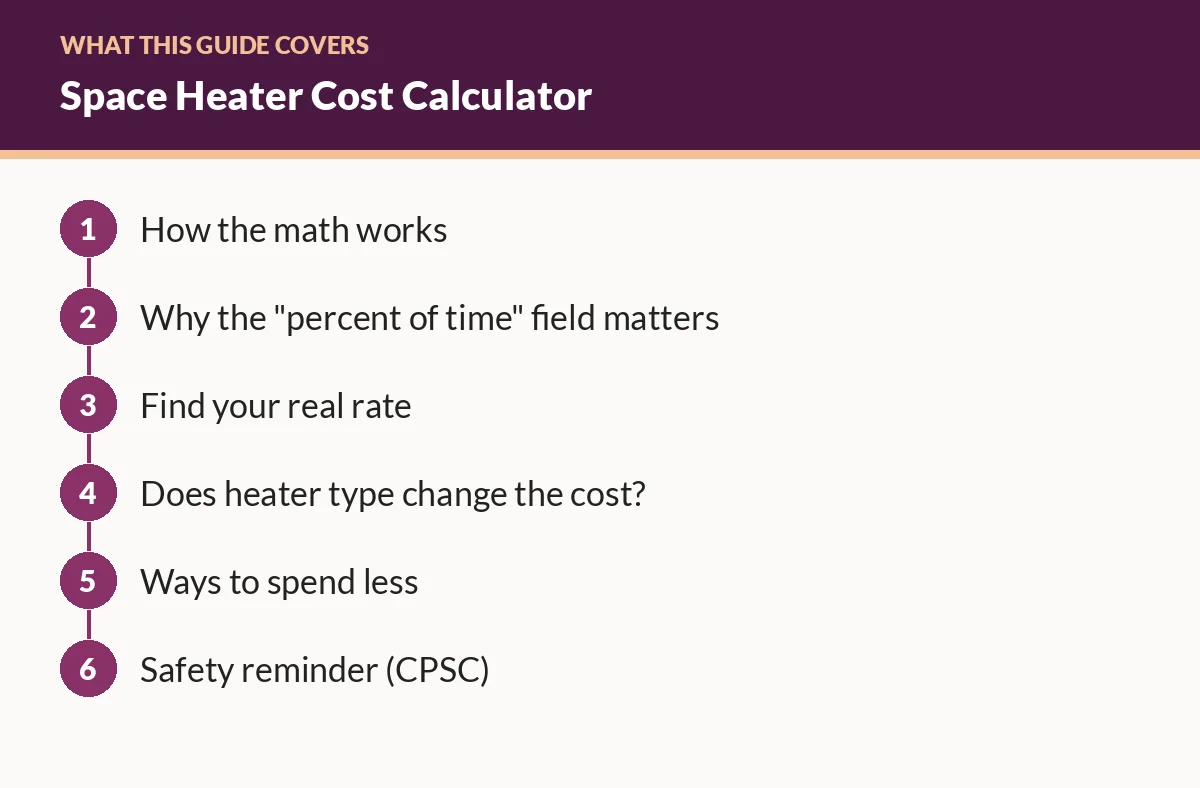
How the math works
- Watts to kilowatts: divide by 1,000. A 1,500 W heater is 1.5 kW.
- Kilowatt-hours: kW × hours of operation. One hour at 1.5 kW = 1.5 kWh.
- Cost: kWh × price per kWh.
Example: a 1,500 W heater on high for 4 hours at the EIA's U.S. average residential price for July 2026 (18.31¢/kWh): 1.5 × 4 × $0.1831 ≈ $1.10 per day, or about $33 per 30 days if used every day. In a state with a lower or higher average, scale accordingly; EIA's July 2026 residential averages ranged from 12.72¢ (Louisiana) to 48.00¢ (Hawaii).
Why the "percent of time" field matters
A heater's watts are its draw while heating. With a thermostat, it switches off once the room reaches the set temperature, then back on as it cools. In a well-sealed small room it may run far less than 100% of the time; in a drafty room, it may run constantly. If you're not sure, start at 100% for a worst case, or use a plug-in energy monitor to measure actual use. Plug-in energy monitors → Amazon
Find your real rate
Your bill shows total charges and kWh used. Divide total electricity charges by kWh for an all-in rate per kWh. That's often more accurate than the state average, because it includes delivery fees.
Does heater type change the cost?
For electric resistance heaters (ceramic, oil-filled, infrared, coil), the cost depends on watts and run time, not type. A 1,500 W heater of any type uses 1.5 kWh per hour while running at full power. Type affects how the heat feels and how fast a room warms, which can change how long you run it. See heater types compared.
Ways to spend less
- Heat the person, not the room: a heated blanket uses far fewer watts than a space heater. Compare with the calculator, and see blanket vs. heater.
- Use a thermostat and timer rather than running on high all day.
- Seal drafts first: see cheap draft fixes.
- Close the door to the room you're heating.
Safety reminder (CPSC)
Keep heaters at least three feet from drapes, furniture, and bedding; plug electric heaters directly into a wall outlet, never an extension cord or power strip; and turn heaters off when sleeping.
FAQ
How much does a 1,500-watt space heater cost per hour?
A 1,500 W heater on high uses 1.5 kWh per hour. Multiply by your electricity price. At the EIA's U.S. average residential price for July 2026 (18.31 cents per kWh), that's about 27 cents per hour. Your actual rate may differ; check your bill.
Where do the electricity prices come from?
From the U.S. Energy Information Administration's Electric Power Monthly, Table 5.6.A, average residential price by state for July 2026 (released September 24, 2026). Prices are preliminary and change monthly.
Does a thermostat lower the cost?
Yes. A heater with a thermostat cycles on and off once the room warms up, so its average power is lower than its rated watts. Use the 'percent of time running' field to estimate this.
Related guides
- Space Heater Buying Guide: Safety Features, Sizing, and Cost
- Heated Blanket vs. Space Heater: Which Costs Less?
- Oil-Filled vs. Ceramic vs. Infrared Space Heaters